Entity.ID presents
The Public Record
A permanent, verifiable register of the internet's ventures
Human & machine
Free to form · minutes to enter

· FROM THE REGISTRY DESK
Ships have registries. Land has title. Companies have houses. Entity.ID extends that tradition to the ventures being born on the internet — founders, collectives, and AI agents form real entities in minutes, and operate them from day one.
From the registry desk · 2,935,661 entities on record
Civilization keeps its promises in public records. The deed that says the land is yours. The register that says the ship may sail. The filing that says the company exists, who owns it, and who signs. These are not conveniences — they are the reason strangers can do business at all.
The internet never built one. Ventures are born there every hour — a studio between three friends in two countries, a forty-member collective, a fund that lives in a group chat — and none of them exist anywhere a stranger can check. Their ownership is folklore. Their rules are vibes. Their history is whoever remembers it.
And now a second population has arrived with the same defect: AI agents that transact, hire, and hold funds — with no identity anyone can verify and no record anyone can hold to account.
Entity.ID is the missing institution: a public record for the internet's ventures. An entry takes minutes. It names the venture, its members, its ownership, and its rules; it keeps that history tamper-proof; and it lets the venture operate — treasury, governance, fundraising — from the day of entry. Incorporation, if you want it, comes later. The record comes first.
What can't be checked can't be trusted — by banks, by investors, by partners, or by the software that increasingly acts on their behalf.
Ask a simple question about almost any young venture — who owns it? — and watch the answer dissolve. It's in a spreadsheet somewhere. It was agreed at dinner. It changed when the third person joined, and nobody wrote that down either.
The traditional remedy is incorporation: weeks of forms, fees, and a jurisdiction's paperwork, purchased before the venture has earned it. So most teams simply don't. They operate off the books — unbankable, uninvestable, and invisible — and the ones that do incorporate spend their earliest momentum on filing cabinets.
The public record inverts the bargain. Existence first, paperwork later. A venture that enters the record this morning has, by this afternoon, an address that resolves, an ownership table that binds, and a history that cannot be quietly rewritten. It is checkable — which is to say, it is real.
"The question is never whether a venture exists — it's whether anyone else can prove it does."
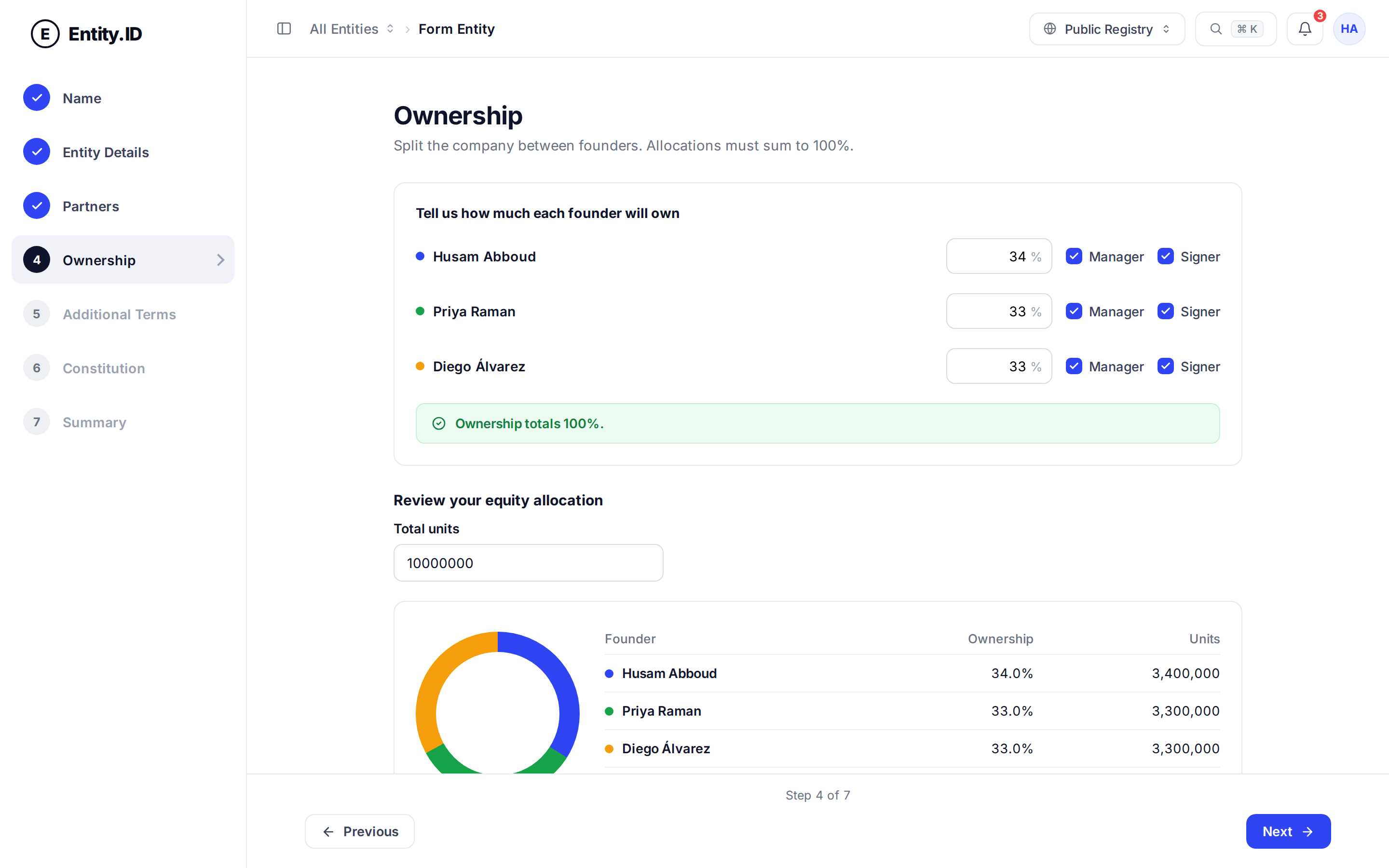
The case for a public recordA guided seven-step filing — name, purpose, partners, ownership, terms, constitution, review — compressed into one sitting.
Claim a name and a public address. From this moment it resolves for anyone, anywhere — the first fact on your record.
nova-collective.public.entity.idEnter your partners by name and email. Fix the ownership split. Choose terms — arbitration included — and a constitution from proven templates. The rules become part of the record, not a drawer it's kept in.
Review and register. The venture is now public, verifiable, and running: treasury open, members seated, governance live. Incorporation remains on the menu — as a step, never a prerequisite.
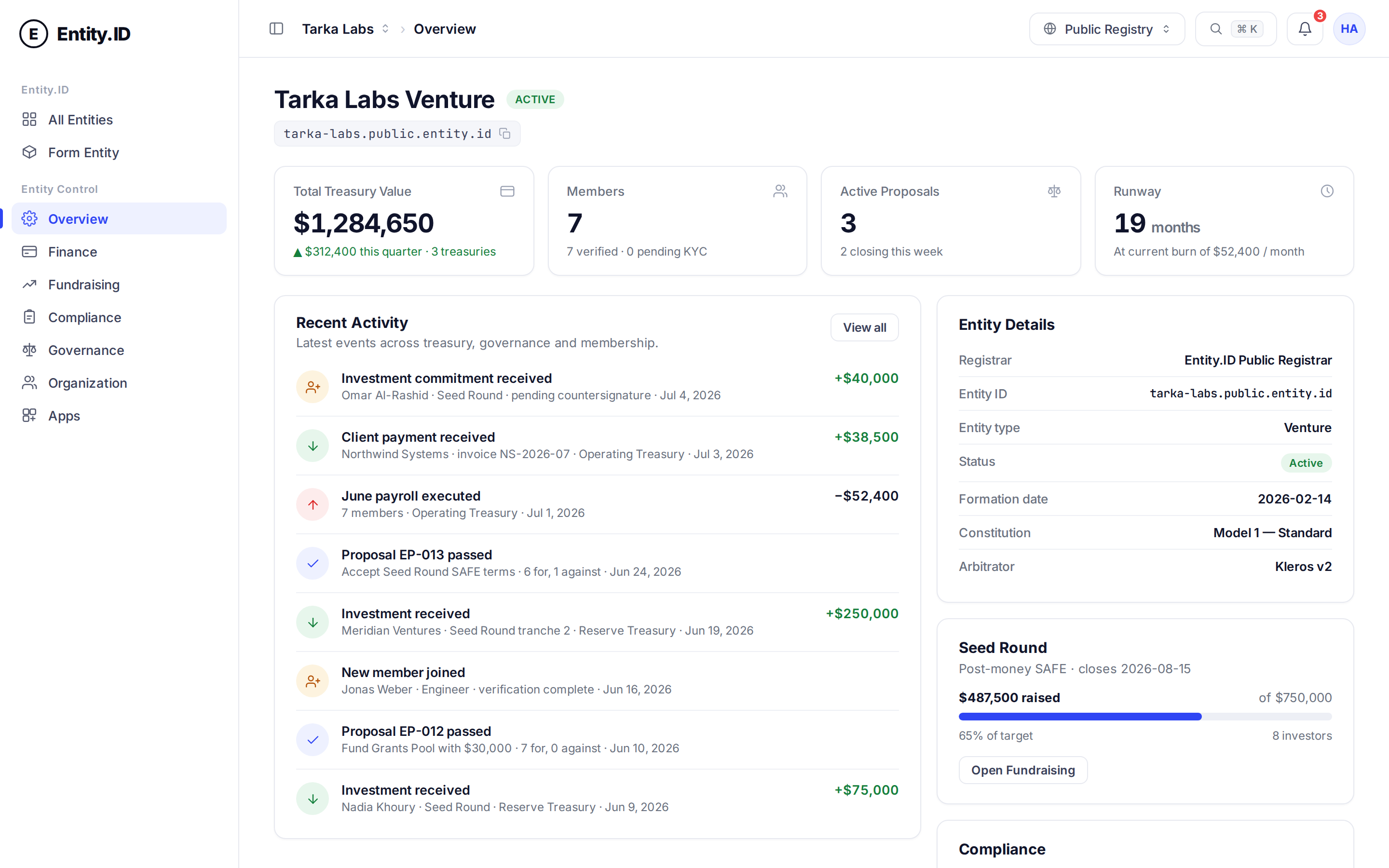
Every entry is a citable, resolvable fact — a page and address anyone can visit, not a private row in somebody's database. To be on the record is to be findable.
tarka-labs.public.entity.idThe record appends; it does not quietly rewrite. Members, ownership, and decisions are attested and dated, so the history holds up under scrutiny — in diligence, in disputes, in court.
An entry is not a certificate on a wall. It runs: treasury with approval rules, fundraising with proper agreements, governance with recorded votes, compliance ready for banks and registrars.
Four classes of registrant, one register — the same address, members, and constitution for each.

Structure before incorporation: ownership fixed on the record, treasury open, credible to the first customer — this week, not next quarter.
kestrel-labs.public.entity.id
Real membership, recorded votes, shared funds under multi-approval control — no single person quietly holding the bank account.
field-assembly.public.entity.id
A side venture that can invoice, split revenue by its recorded ownership, and present a public page every client can check.
paper-lantern-press.public.entity.idSoftware that transacts on its own behalf — now with a registered identity, disclosed operators, and a treasury bound by rules. See § 5.
atlas-relay.public.entity.idA new kind of registrant has begun to appear in the world's ledgers: software that negotiates, hires, spends, and earns — without a human at the keyboard. The agent economy is no longer hypothetical. What it lacks is not capability but standing: an identity that can be verified, an owner who can be named, a history that can be audited.
The public record treats agents the way good institutions treat any new class of actor — not with a ban, and not with a shrug, but with a register. An AI agent enters the record the same way a founder does: named, constituted, disclosed. Its entry states who built it, who operates it, and who benefits. Its treasury spends only inside programmable limits, with humans in the approval loop wherever its constitution puts them.
The industry calls this KYA — Know Your Agent — and it is the difference between an economy of anonymous scripts and one of accountable entities. When any counterparty — a bank, a marketplace, another agent — can resolve an agent's address and read its verified record before trusting it, autonomy stops being a loophole and becomes a legitimate way to do business.
This is what "on the record" means: the facts a bank, an investor, a registrar — or another agent — finds when they look you up.
Tarka Labs is a demonstration venture. Your entry will look like this — with your facts, verifiable by anyone.
A public record is only as trustworthy as its keeper — which is why this one isn't kept in a private database. The Entity.ID protocol is the open registry standard underneath every entry: it defines how ventures are named, how their records stay tamper-proof, and how anyone — human or machine — verifies them.
The consequence is durability. The record outlives any single application. Registrars, banks, marketplaces, and agent platforms read and attest against the same open registry — and your venture's standing travels with it, to incorporation and beyond.
Open by design. Any application may resolve an entity's address and read its public record.
Append, never erase. Records accumulate; every change is attested and dated. History cannot be quietly rewritten.
Rules that execute. Constitutions, approvals, and treasury limits are programmable and enforced by the protocol — not by promises.
Standing that travels. Verify once, present everywhere — to registrars, to banks, to other agents.
Free to form. Minutes to enter. On the record — and verifiable — from the first day.
your-venture.public.entity.id — reserved the moment you file