Every jurisdiction has a company registry. The internet doesn't.
Entity.ID is the internet's entity registry. Form a venture in minutes and get a public, tamper-proof record — identity, ownership, and good standing anyone can check. For founders, for collectives, and for AI agents. Operate today; incorporate when you need to.
KYC for ventures · KYA for agents · one registry, one lookup.
This is what existence looks like.
One entry in the registry. Public. Tamper-proof. Enough for any counterparty — a bank, a client, another agent — to know exactly who they're dealing with.
SPECIMEN RECORD — TARKA LABS IS A DEMONSTRATION VENTURE.
Trust in private ventures still terminates in a filing cabinet.
A record ~5.6 million new US business applications were filed in 2025 — and the infrastructure behind them hasn't changed in decades.
Paperwork, then silence.
Incorporation platforms end at the filing. Nothing exists before it; nothing operates after it. Members, rules, money, and governance are left to spreadsheets and handshakes.
The vendor is the trust model.
Ownership records live in private databases. In 2024 a cap-table vendor's employee misused confidential investor data — the company exited secondary trading "to prioritize trust." A public record can't fail that way.
Agents can pay. They can't exist.
Every major payment network shipped agent rails in 18 months. ~69,000 agents already transact ~$600M a year over one protocol alone — with no legal identity behind any of them.
Registries stop at the border.
Every company registry is bound to one legislature and one paper era. Internet-native ventures aren't — their members, clients, and counterparties are everywhere.
Declared. Recorded. Operating.
From a name to a venture in good standing — in minutes, not weeks.
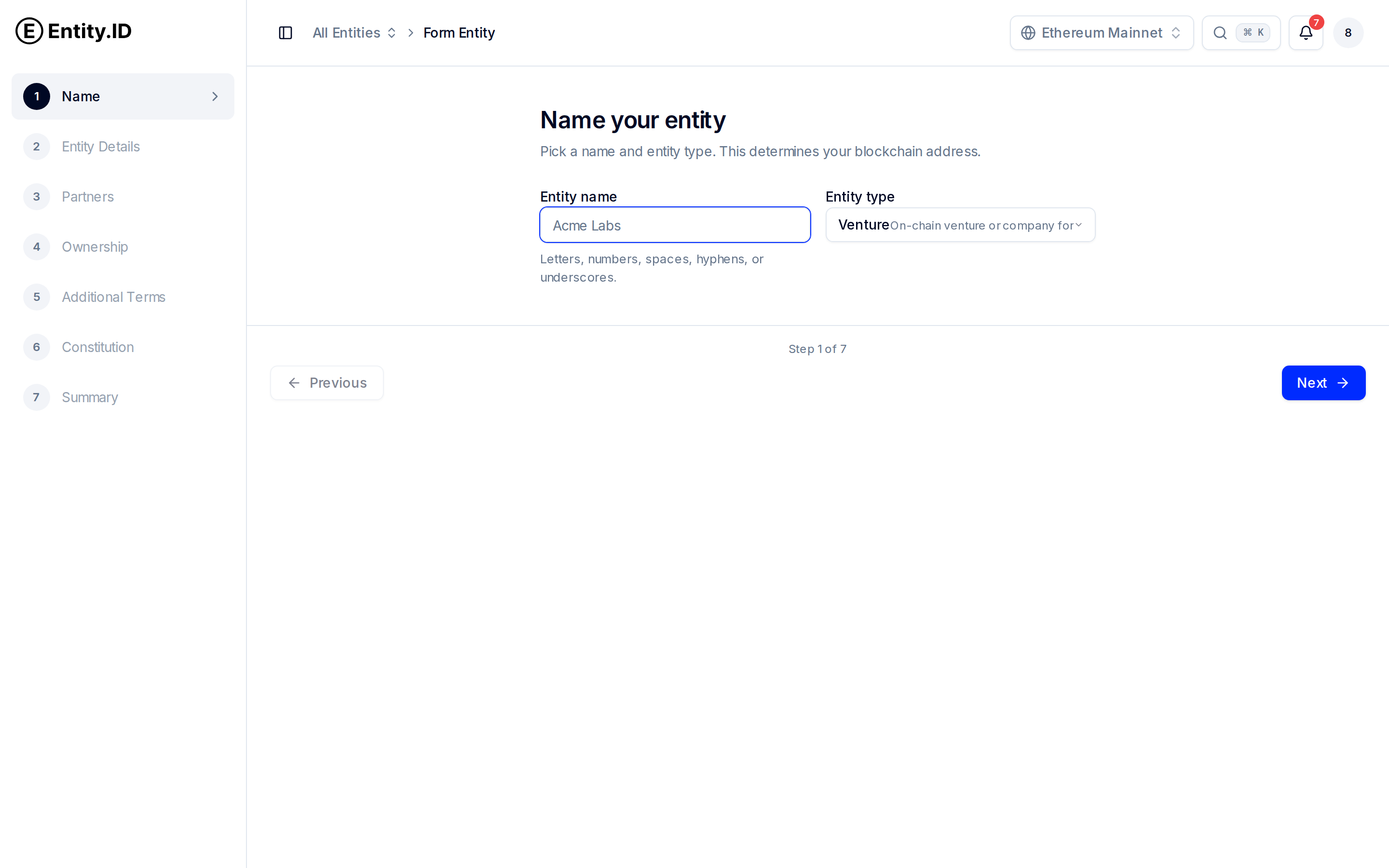
Declare.
Name, purpose, partners, ownership split, terms, and a constitution — a guided 7-step formation. Arbitration and governance chosen up front, not litigated later.
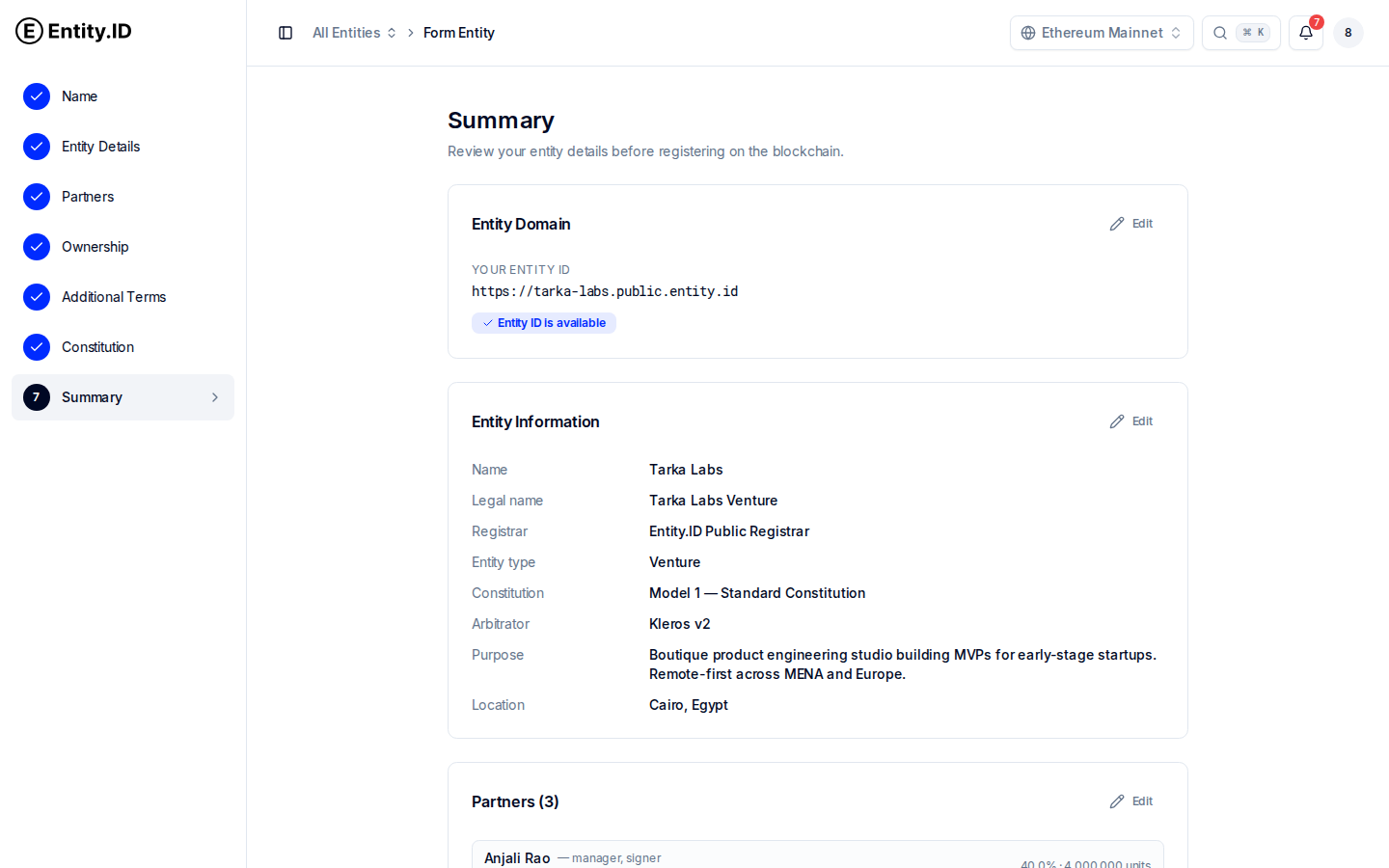
Recorded.
Your venture enters the public registry at an address like tarka-labs.public.entity.id — a tamper-proof record with verification marks anyone can check, forever.
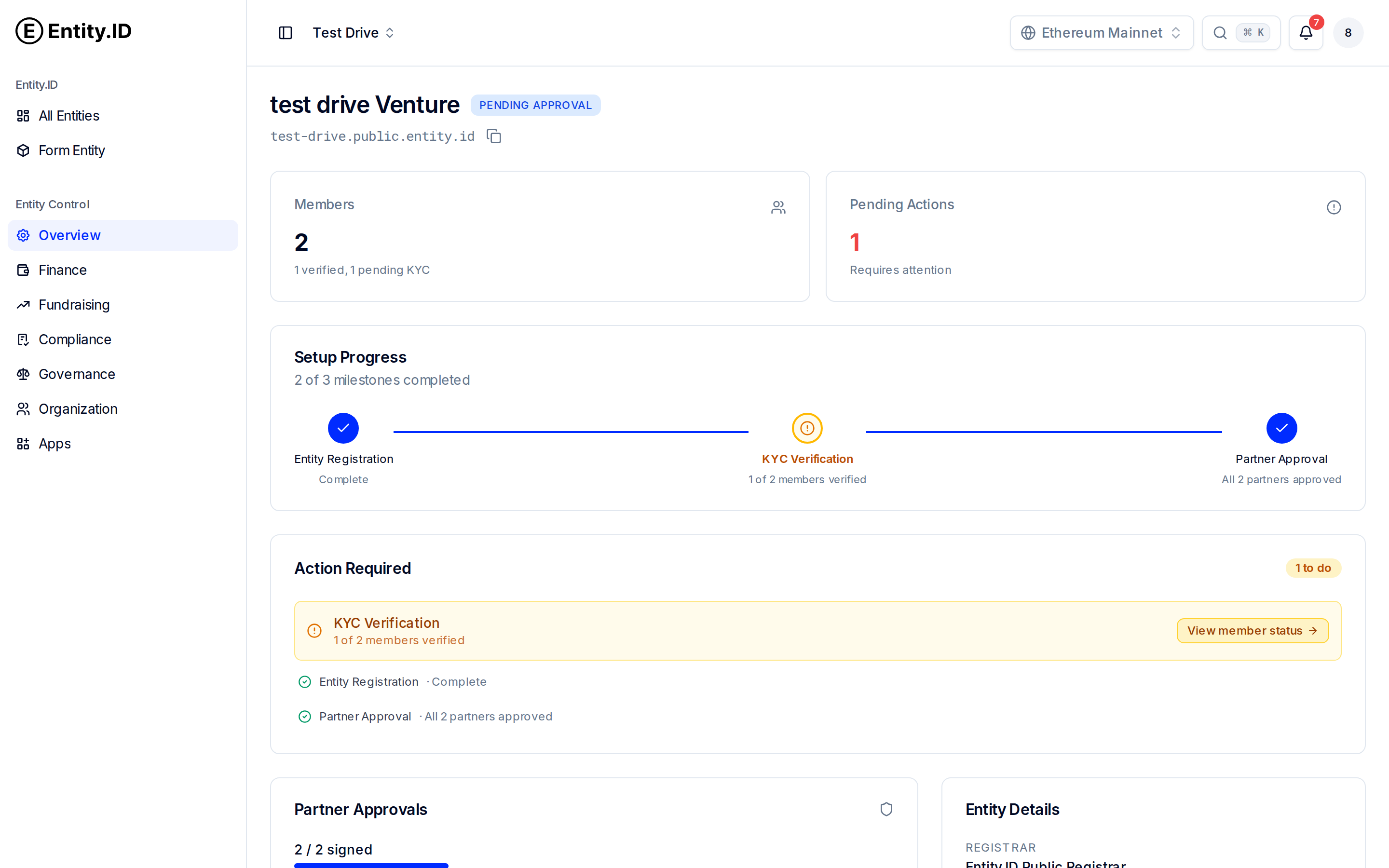
Operate.
Treasury, fundraising, governance, members, and compliance — live from day one. Incorporate into a traditional legal entity whenever you're ready. Or never.
What a registry owes the public.
A record, not a vendor.
The registry entry is public and tamper-proof. Verification doesn't require trusting us — any counterparty checks the record directly, the way you'd check a court filing. The trust anchor is the record itself.
Standing for every actor.
Humans, collectives, and AI agents register as first-class subjects — each with verifiable identity, a disclosed owner chain, rules on record, and a standing status checkable before any transaction.
An open standard.
Underneath is the Entity.ID protocol — an open registry standard any platform, marketplace, or payment rail can integrate. A registry only matters if everyone can read it.
Anything the internet creates can be on the record.
FOUNDING TEAMSStructure before the filing
Ownership, rules, and a treasury from day one — before (or instead of) incorporation. No more "we'll sort the split later."
COLLECTIVES & CLUBSMembers without the liability void
A named entity with recorded governance — so an unstructured group is never one lawsuit away from personal liability.
AGENCIES & STUDIOSAn identity clients can check
A public record of who you are, who owns you, and that you're in good standing — attached to every proposal you send.
AI AGENTS & OPERATORSStanding, disclosed, verifiable
Agents register within entities anchored to accountable owners — and carry a status any counterparty can verify. KYA, built in.
Agents got payment rails.
Entity.ID gives them standing.
An AI agent registers as — or within — an entity, which anchors it to the accountable humans or companies behind it. What corporate personhood did for companies, registration does for agents: a recognizable subject of rights and obligations, without pretending it's human.
Registered ↔ registered: two entities transact formally because each carries a record the other can check.
Before transacting, a counterparty runs one standing check — the way banks run KYC. The agent's compliance model follows from where it's registered, automatically and machine-readably. Identity standards and payment rails already exist; Entity.ID supplies the layer none of them define: what legal thing is on the other end.
Check any entity's standing.
Ventures and agents alike. One lookup — no phone calls, no PDFs, no trusting the vendor.
DEMONSTRATION LOOKUP — SPECIMEN DATA ONLY.
This is the whole trust model: the record answers, so nobody has to take anybody's word.
Registries are products. The numbers say so.
Annual state revenue from e-Residency — 132,000+ e-residents, marketed with live public counters. A registry earns trust by publishing its own numbers.
Record new business applications in a single year — and 30.4M existing US businesses have zero employees. Most will never incorporate. None have a public record.
LegalZoom's yearly revenue from filings in a ~4%-growth market — while the category consolidates instead of innovating. The registry layer is worth more than the paperwork layer.
Regulators are converging on registration, disclosure, and agent verification — from Brussels to FINRA. We're building the registry they will ask for.
EU AI ACT ART. 50 · FINRA 2026 · FSB JUN 2026 · NIST RFI MAR 2026The Entity.ID protocol.
An open registry standard: a record schema for identity, ownership, constitution, and standing; verification marks; and a standing check any platform can call.
The protocol consumes the standards the ecosystem already shipped — agent identity cards, signed requests, payment mandates — and supplies the one layer none of them define: the entity. Who owns the actor, what rules bind it, and whether it's in good standing.
Open by design, because a registry only becomes the source of truth when anyone can read it and everyone can build on it — marketplaces, banks, payment rails, and other agents.
A public map of who owns what — and who answers for whom.
Every venture, member, and agent, connected by disclosed ownership and recorded rules. The internet has been the world's largest economy with no registry of record.
That ends now.
Get on the record.
Formation takes minutes. The record lasts.