The venture operating system

The operating system a venture runs on.

Form a real venture in minutes. Treasury, members, fundraising, governance, and compliance come online the moment you register — and incorporation becomes a feature you add when you need it, not a gate you wait behind.

for founders · collectives · AI agents — recorded on the Entity.ID protocol

entity.id — venture boot
LIVE

Overview

The venture at a glance — record, standing, activity.

LIVE

Treasury

Shared money with every movement on the record.

LIVE

Fundraising

Raise from members and backers, terms recorded.

LIVE

Governance

Proposals, votes, and decisions that execute.

LIVE

Members

Humans and agents — roles, ownership, standing.

LIVE

Compliance

Your rules, watched continuously by the back-office.

LIVE

Apps

Extend the venture with tools built on the protocol.

§
OPTIONAL

Incorporation

Install the legal wrapper when — if — you need it.

Everything a venture needs to run, live from minute one. One thing it doesn't need yet — clearly marked.

The gap

Every venture tool starts
after the moment that matters.

Before a certificate of incorporation exists, a venture can't get a cap table — Carta requires the certificate just to onboard. It can't take an RUV — AngelList only funds incorporated companies. And the platforms that create the certificate hand you a PDF and stop. So the riskiest phase of every venture — money in, roles unwritten, decisions unrecorded — runs on handshakes and someone's personal bank account.

The incumbent stack — Atlas · LegalZoom · Carta · AngelList
idea → handshakes → spreadsheets (nothing exists)
⨯ filing gate
the stack finally begins
weeks-to-months of unstructured risk — where courts see a general partnership with personal liability
Entity.ID — the venture operating system
venture live: treasury · members · governance · compliance — from the idea
§ incorporate (optional)
operate today — incorporate when you need to. no competitor can say this.
5.62M

US business applications in 2025 — an all-time record, tracking higher in 2026.

US Census BFS
30.4M

US businesses with zero employees — over 4 in 5 US businesses, $1.8T in receipts, mostly never incorporating.

US Census, 2023 Nonemployer Statistics
1 lawsuit

is all it took for a US court to treat an unstructured collective's members as personally liable general partners.

Samuels v. Lido DAO, 2025
How it works

Boot a venture in three moves.

01

Boot — minutes, not weeks

Seven guided steps: name, purpose, members, ownership split, terms, constitution, review. Your venture lands on the public registry at an address like tarka-labs.public.entity.id — tamper-proof from the first second.
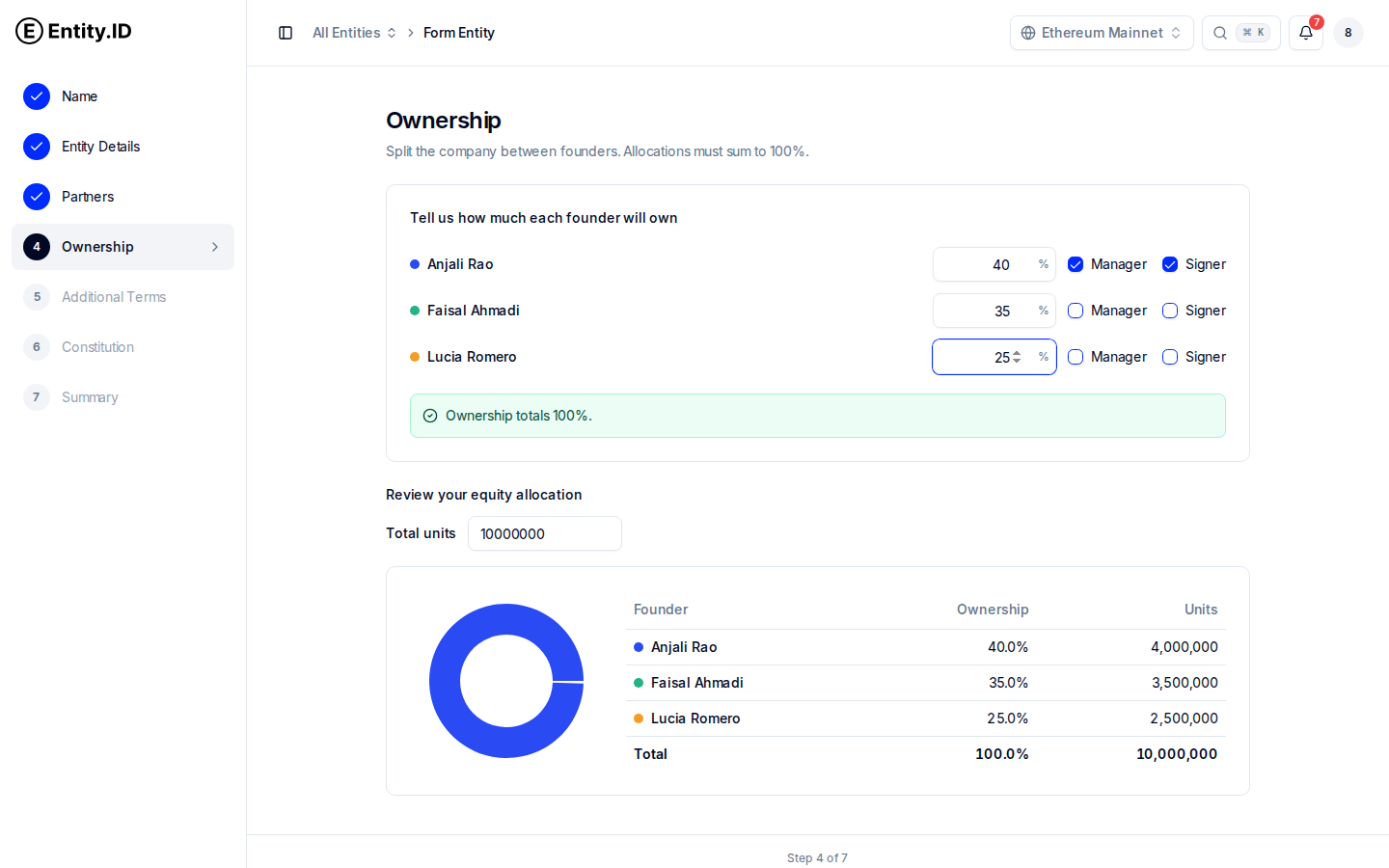
Formation wizard — ownership split step
02

Run — live on registration

The dashboard is on the moment you register: treasury and finance, fundraising, governance and voting, members and roles, compliance. Your AI back-office files, records, and watches the rules — so nobody on the team has to become the paperwork person.
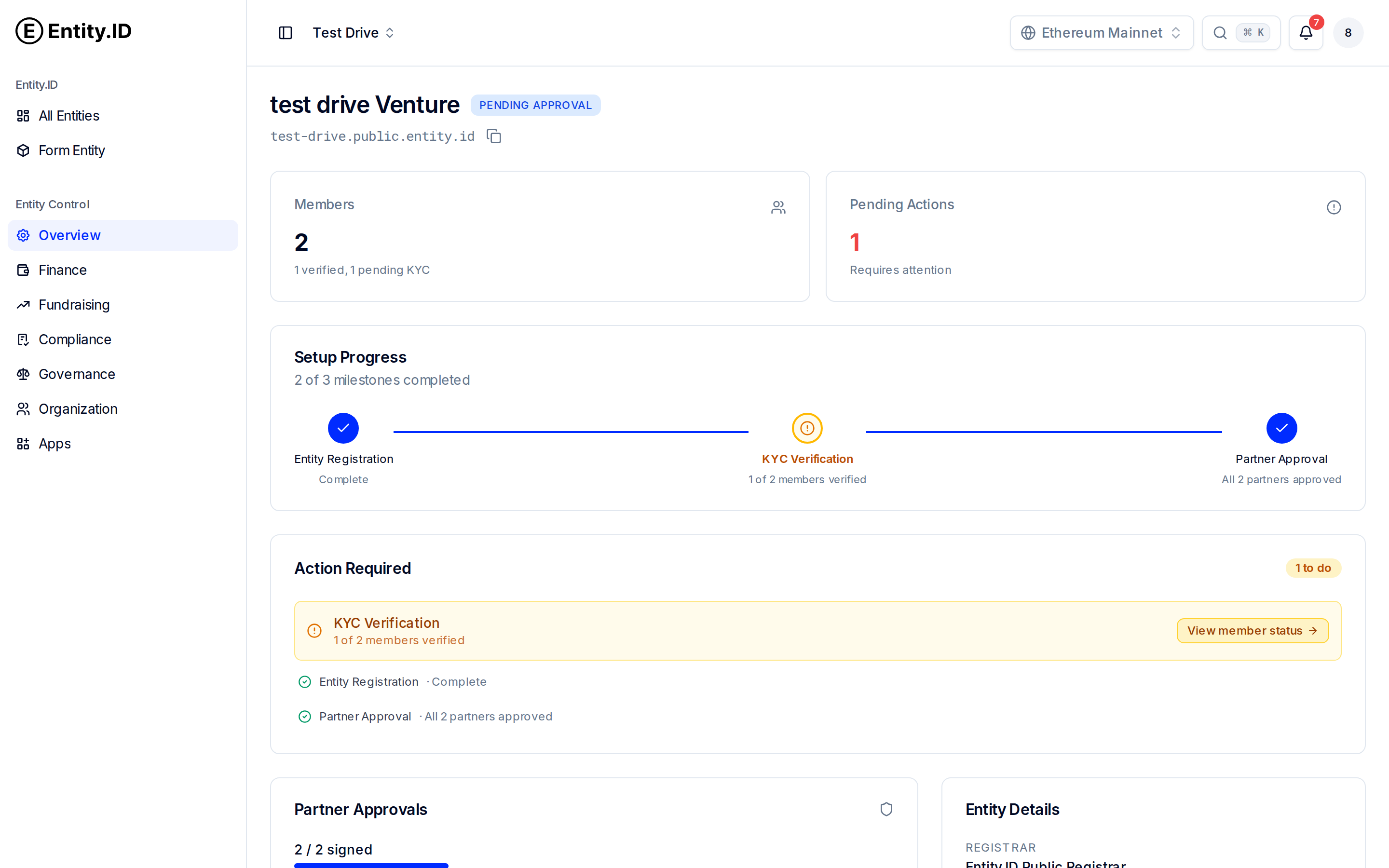
Venture dashboard overview
03

Incorporate — when you need to

Raising a priced round? Signing an enterprise contract? Install the incorporation module and carry your record, ownership, and history into a traditional legal entity. Until then — skip the filing fees and the franchise tax.

$ venture install incorporation
→ optional module · jurisdiction-dependent
record, members & history carry over ✓
until then: fully operational without it
The tour

Watch a venture run.

Seventy-two seconds inside a live venture — treasury to governance to compliance.

Dashboard tour video poster
DASHBOARD TOUR · 1:12
The bets

One system. Three bets.

PILLAR / 01

Day-zero operations

A venture that runs the moment it exists. Not documents in a folder — live modules: money, members, decisions, rules. The work incumbents leave to handshakes is the work Entity.ID structures first.

the stack starts at the idea, not the filing
PILLAR / 02

An AI back-office, built in

Filings, records, minutes, compliance posture — paperwork is agent work now. Every venture ships with an AI back-office, so a founding team of one operates like a company of fifty.

nobody has to become the paperwork person
PILLAR / 03

Agents with standing

The first venture layer where an AI agent can be a member, an operator — or the venture itself — anchored to accountable humans, with verifiable identity and a machine-readable compliance model.

KYA — know your agent
The modules

The modules, up close.

Module screenshot
The venture at a glance — standing, activity, and every module one click away.● overview: LIVE
Who it's for

Built for whoever builds next.

Founding teams

Structure before the lawyer.

Ownership agreed, money separated, decisions on the record — before you've spent a dollar on legal. Incorporate when it's real; protected in the meantime.

Collectives & clubs

Shared money, shared say.

Pool funds and make decisions together without one member's name on everything — and without the personal liability courts assign to structureless groups.

Studios & agencies

A venture per project.

Spin up a venture for each client, collab, or experiment — its own treasury, members, and rules — and archive it cleanly when the work ends.

AI agents & operators

Give your agent standing.

Register the agent, disclose the chain of accountability, hand it a treasury and rules it must obey. Counterparties verify before they transact.

Know your agent

Agents got payment rails.
We give them existence.

Between April 2025 and June 2026, every major payment network shipped agent-payment rails. Roughly 69,000 agents already transact some $600M a year over a single protocol — and not one of them legally exists. The first AI to earn a million dollars has no lawful way to own it.

Entity.ID closes the gap. An agent registers as — or within — a venture, anchored to accountable humans, with verifiable identity, a treasury, and a machine-readable compliance model. Counterparties check standing before transacting, the way banks run KYC. Recognized ↔ recognized.

EU AI Act Art. 50 — agent disclosure, Aug 2026 FINRA 2026 — first AI-agent risk section NIST RFI — agent identity, Mar 2026
AGENT RECORD — KYAstanding: verified
agentatlas-7
member oftarka-labs.public.entity.id
operators2 humans — disclosed
compliance modelmodel-2 · machine-readable
treasury authorityscoped · rules enforced
recordpublic · tamper-proof
checkable byany counterparty, human or machine
Proof & standards

The moment, in numbers.

+130%

YoY growth in Stripe Atlas incorporations, Q1 2026 — AI is minting founders faster than the legal system was designed for.

Stripe Atlas
~$600M

annualized volume already transacted by ~69,000 AI agents over one payment protocol — none with legal identity.

Coinbase x402, spring 2026
40%

of enterprise apps will ship task-specific AI agents by end of 2026 — up from under 5% in 2025.

Gartner
18 months

for Visa, Mastercard, Stripe+OpenAI, Google, PayPal, and Coinbase to all ship agent-payment rails. Agents can pay. They can't yet exist.

Industry announcements, Apr 2025 – Jun 2026
€125M

Estonia's e-Residency revenue in 2025 — proof that a registry, run well, is a product people pay for.

e-Residency / ERR News
$756M

LegalZoom's yearly revenue from paperwork alone, in a market growing ~4% a year — the money is real; the product stopped evolving.

LegalZoom FY2025, SEC filings
The Entity.ID protocol

The record, not the vendor,
is the trust anchor.

Underneath the product is an open registry standard. Every venture is a public, tamper-proof record at a human-readable address — who it is, who's behind it, what rules it runs by. When records live in a vendor's private database, the vendor is the trust model — and that model has already failed in public. A registry is only neutral if no one, including us, can quietly rewrite it.

public record

Verifiable by anyone — a founder doing diligence, a bank running checks, or another agent deciding whether to transact.

open standard

Registrars, verifiers, and apps can build on the protocol without asking us. The registry outlives any single company — including this one.

programmable rules

A venture's constitution executes — ownership, spending authority, and voting are enforced by the system, not just described in a document.

The vision

The org chart is shrinking — the first billion-dollar one-employee company is expected within a year — while ventures per person go up and ventures per agent start at zero today. When starting a venture is a boot sequence instead of a legal project, people will run ventures the way they run apps: many at once, some for a weekend, some forever. The venture operating system is how that world stays accountable.

// the next million ventures won't be filed. they'll boot.

Boot yours.

A real venture — named, membered, recorded — before your coffee cools.