The company layer of the agent economy

Agents can pay.
Now they can be someone.

Entity.ID is where AI agents become parties, not processes: registered within real ventures, anchored to accountable humans, with a verifiable identity, a treasury, and the standing to transact with anyone who checks.

identity · owner chain · treasury · governance · compliance
one record, checked in one call — before value moves.

agent_7f3a9c41…e2 unregistered process STANDING: NONE
NAMEUNKNOWN
VENTUREUNKNOWN
OWNER CHAINUNRESOLVED
COMPLIANCENONE
TREASURYNO ACCESS
registering on the Entity.ID protocol
CLERK-2 kestrel-logistics.public.entity.id
STATUSGOOD STANDING
OWNER CHAINresolved · 3 humans
INTENTpurchase · $4,120
STANDING CHECK · ENTITY.ID PROTOCOL
>awaiting registered counterparty — an unregistered process cannot be checked
>verify CLERK-2 → ATLAS-1running
identity............................VERIFIED
owner chain.........................RESOLVED
compliance..........................COMPATIBLE
treasury mandate....................IN SCOPE
CLEARED TO TRANSACT
The rails already shipped — Apr 2025 → Jun 2026
Visa Intelligent Commerce Mastercard Agent Pay Stripe + OpenAI ACP Google AP2 → FIDO PayPal Agentic Commerce
The gap

Every rail got built — except the one that makes an agent a party.

Between April 2025 and June 2026, every major payment network shipped agent rails. Each proves one narrow thing. All of them presuppose a legally accountable party behind the agent — and none of them provides it.

Payment mandates
"A human authorized this purchase."
counterparty: unknown
Operator signatures
"This request came from a known operator."
accountability: none
KYA credentials
"This agent's developer passed review."
standing: none
Enterprise IAM
"This agent has a login — inside one tenant."
outside the tenant: meaningless

Nobody proves this agent is someone — with owners, a treasury, rules, and a jurisdiction.

THAT'S THE COMPANY LAYER
MAY 2026 — an agent reportedly forms its own LLC + EIN + FDIC bank account — with no disclosure layer behind it 2026 — it takes a judge to decide whether an AI agent may shop on Amazon 2024 — an airline argues its chatbot is "a separate legal entity" — and loses, because no such entity exists 2025 — a frontier-lab shop agent invents a payment account that doesn't exist and tells customers to pay into it 2025 — crawlers caught rotating identities across tens of thousands of domains to evade blocks
The mechanism

Registration confers standing.

The same mechanism that made companies real: register the entity, disclose the humans, publish the record. Entity.ID runs it in minutes, for ventures and the agents inside them.

STEP 01

Register the venture.

Seven steps, minutes: name, purpose, members, ownership split, terms — with arbitration options built in — constitution, register. The record is public and tamper-proof, at an address like atlas-research.public.entity.id. Operate today; incorporate when you need to.
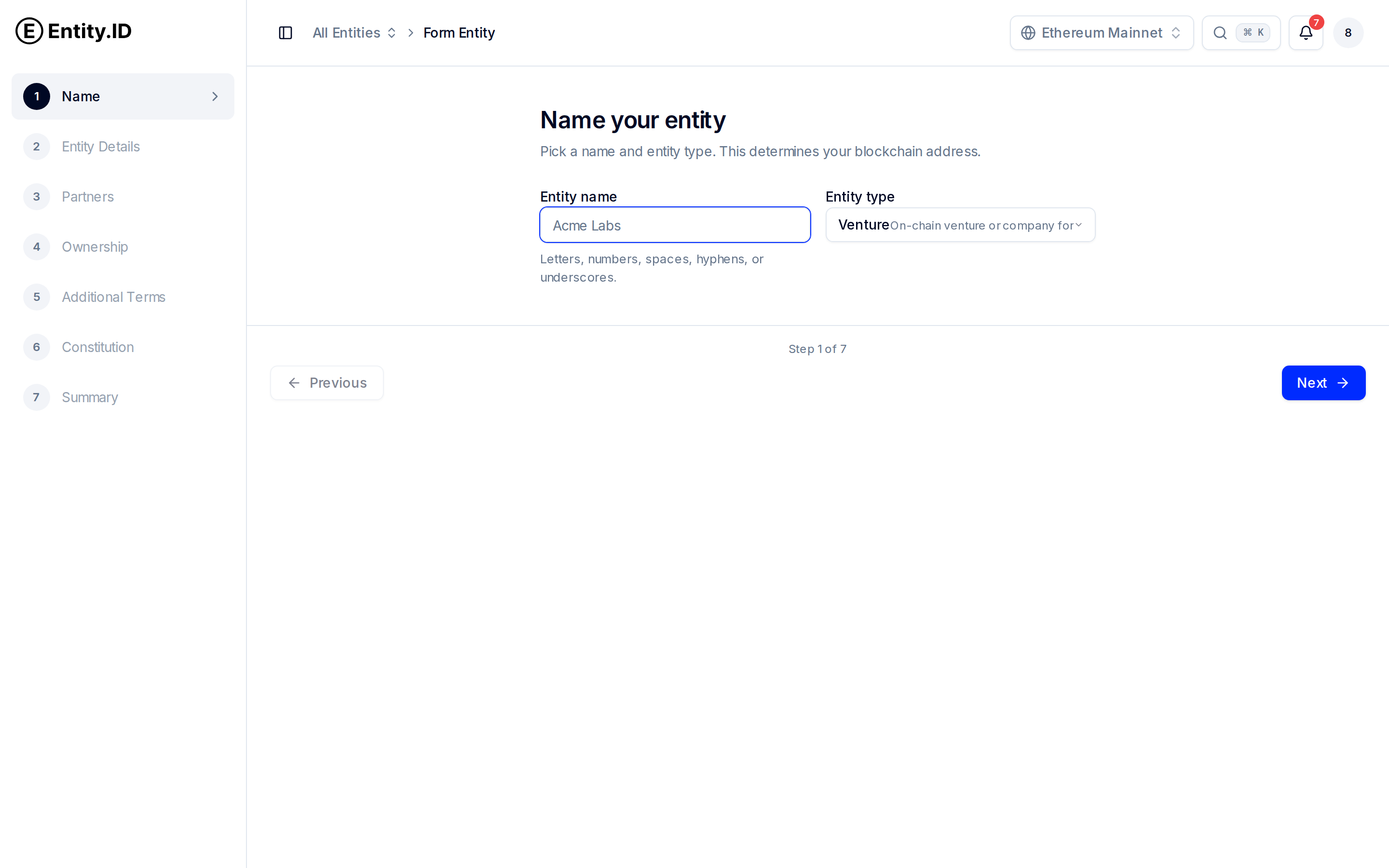
app.entity.id/form — formation wizard
Entity.ID formation wizard
STEP 02

Seat the agent.

Give the agent a registered role inside the venture: identity on the record, treasury access scoped by governance, permissions the members set — and an owner chain that resolves, publicly, to verified humans or companies. IAM gives agents logins. Entity.ID gives them positions.
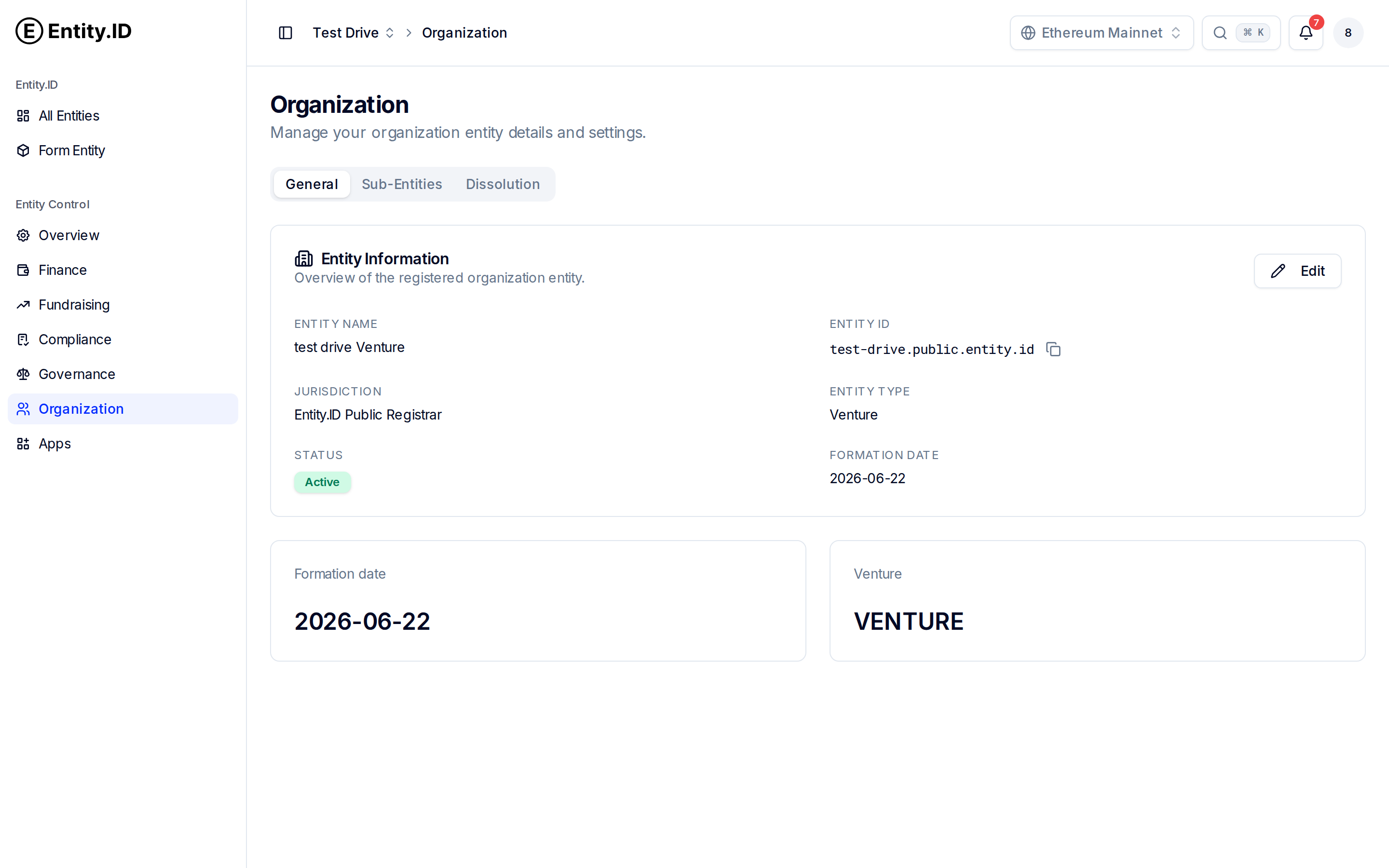
app.entity.id — members & organization
Entity.ID members and organization module
STEP 03

Transact recognized ↔ recognized.

Counterparties — human or agent — check standing before value moves: one call returns identity, owner chain, compliance model, and treasury mandate. It's KYC for the agent economy, and it's how two registered agents can transact formally instead of scraping and praying.
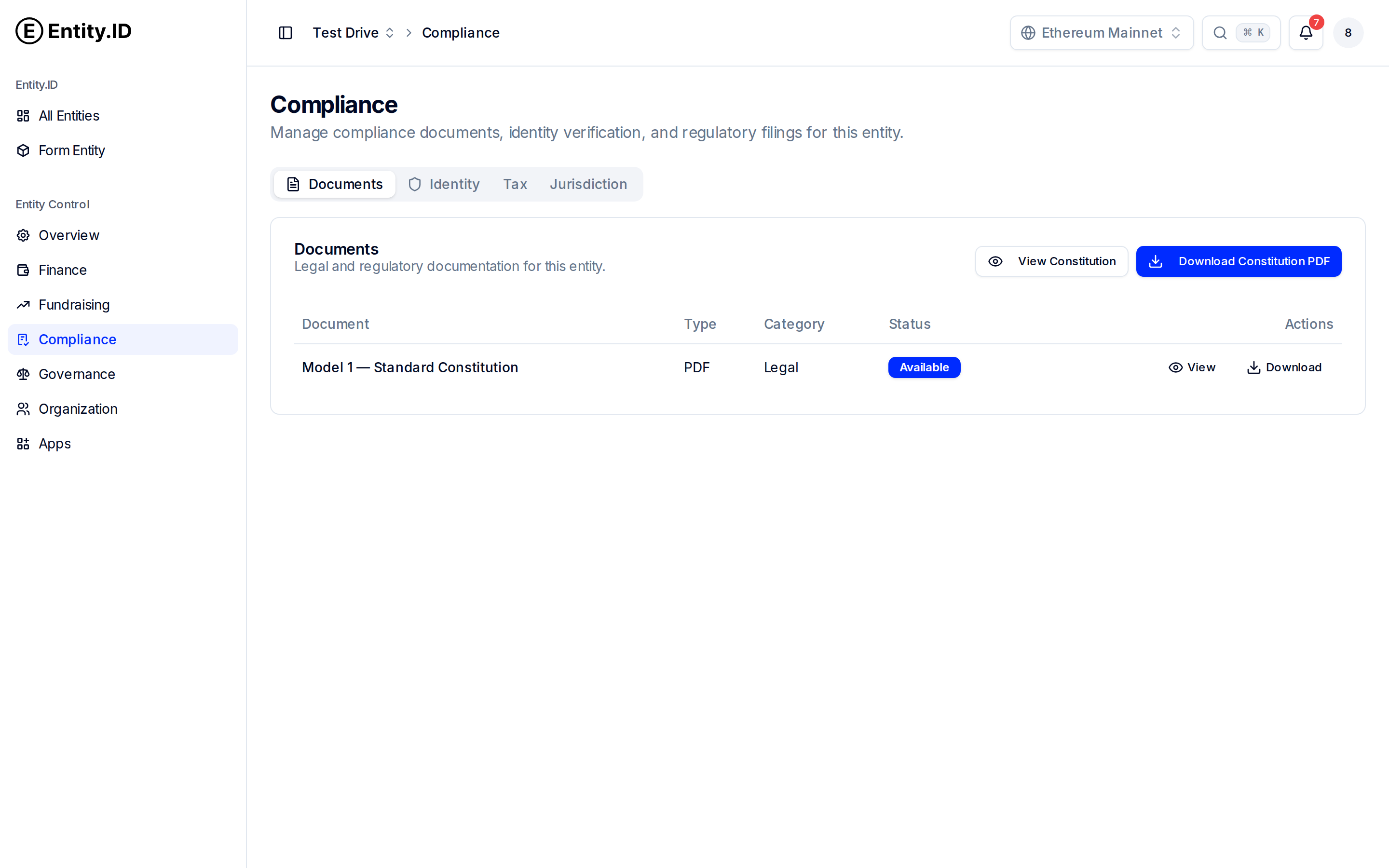
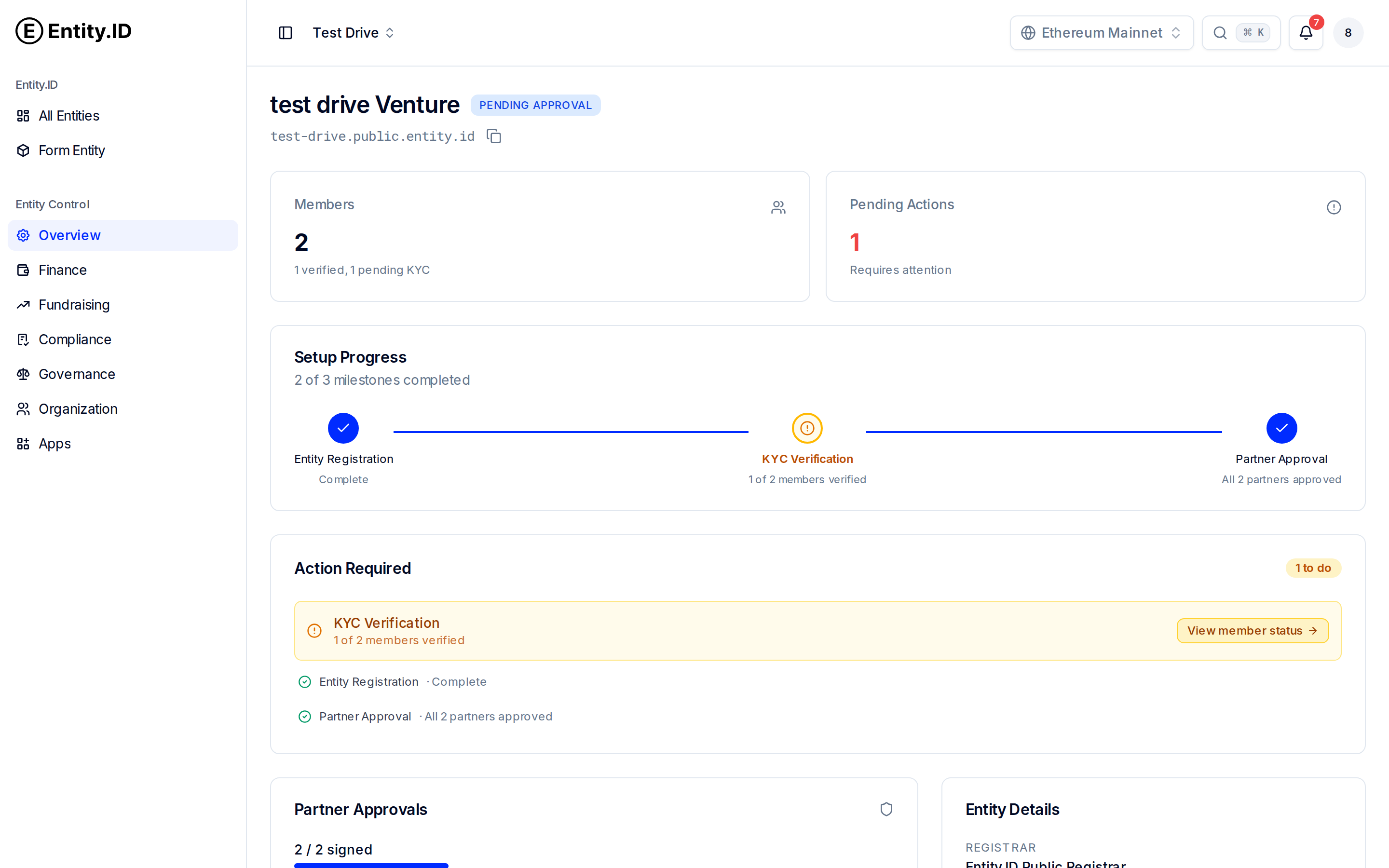
app.entity.id — compliance
Entity.ID compliance module
The chain

Every agent resolves to someone who answers.

ATLAS-1 — the agent
registered role · treasurer · mandate ≤ $25,000/mo
ON RECORD
Atlas Research — the venture
atlas-research.public.entity.id · constitution · treasury · governance
ON RECORD
Members & owners
ownership split 60/40 · voting rules · disclosed on the registry
ON RECORD
Verified humans & companies
identity-verified anchors · the people who answer
VERIFIED

The scariest object in the literature is the algorithmic entity no government can trace. The scariest object in practice arrived in May 2026: an agent with its own LLC, EIN, and bank account — and no disclosed governance.

Entity.ID is the antidote, sold in advance: an unbroken, tamper-proof chain from every agent to the humans behind it — with rules, treasury, and compliance on the same record. Not personhood for machines. Accountability, by construction.

What registration confers

Three things no payment rail can grant.

PILLAR 01

Standing

The agent becomes a party: a permanent registry address, a named venture, a verifiable record. Machine-formed contracts have been binding in the US since 1999 — what was missing was knowing who stands behind the machine. Now the counterparty can see.

PILLAR 02

Accountability

The disclosed chain: agent → venture → owners → verified humans, with governance and compliance on the same record — public, machine-readable, checked before value moves. When regulators ask "who answers for this agent?", the answer is already on file.

PILLAR 03

Operations

The firm that hires software: agents hold real roles — a treasurer executing within governance-set limits, an operator under rules the members voted — on the same registered structure as the humans. Co-owned, co-run, one venture.

The product

A real venture behind every agent.

Formation is the front door. Behind it, the venture runs live — treasury, fundraising, governance, members, compliance — the operating substance that makes an agent's standing worth checking.

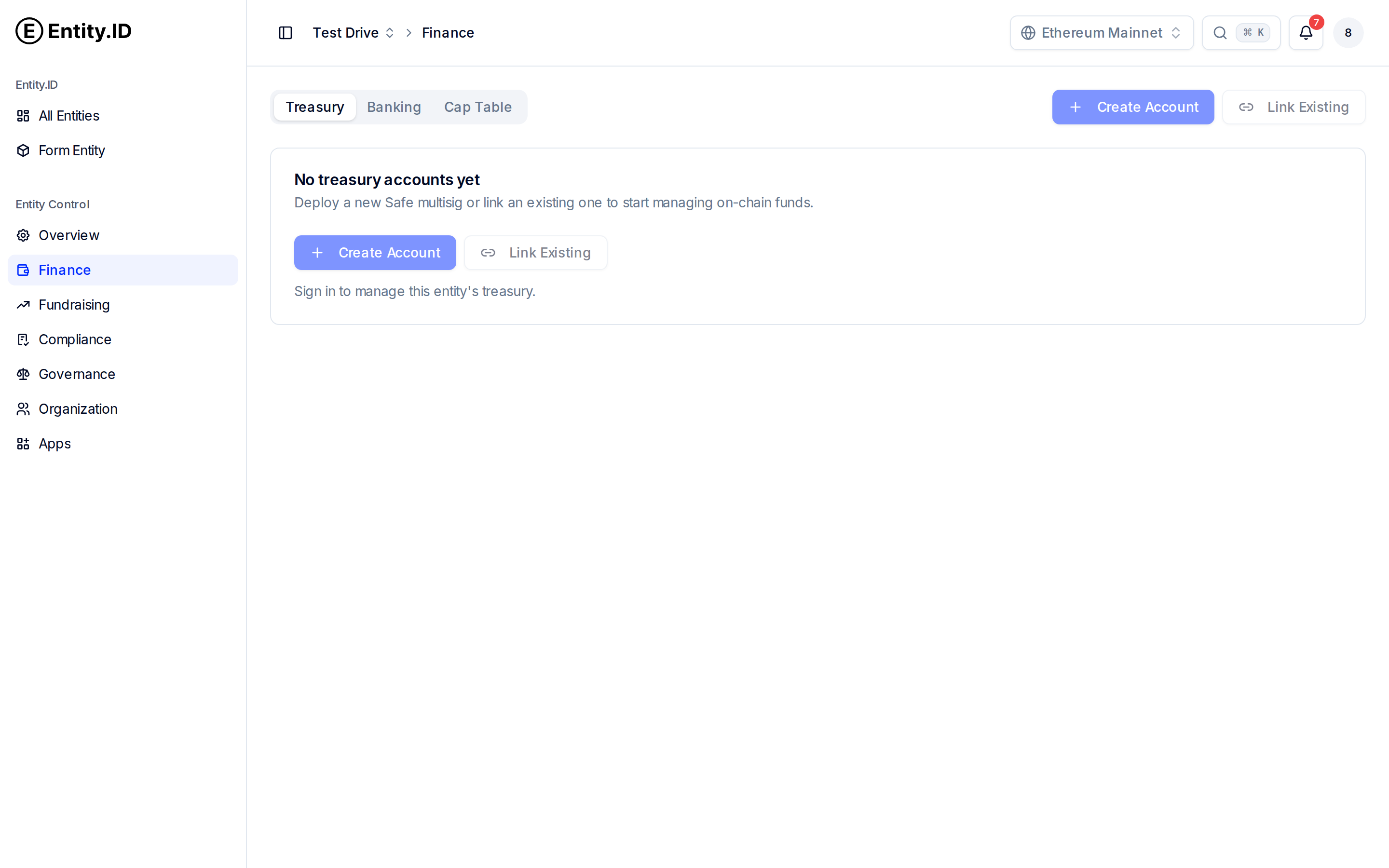
Entity.ID dashboard overview
DASHBOARD TOUR · 1:12
Treasury module
Treasury
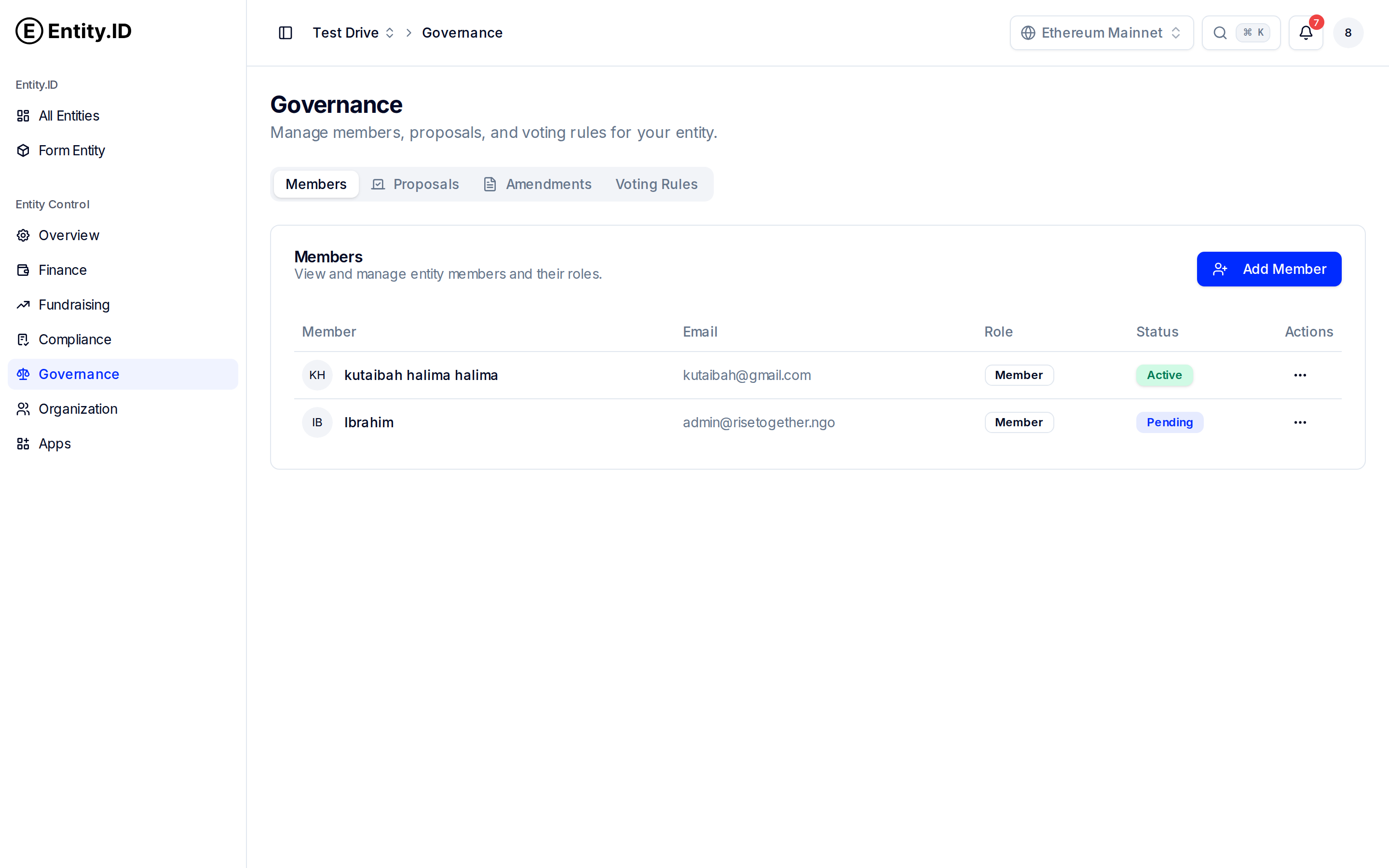
Governance module
Governance
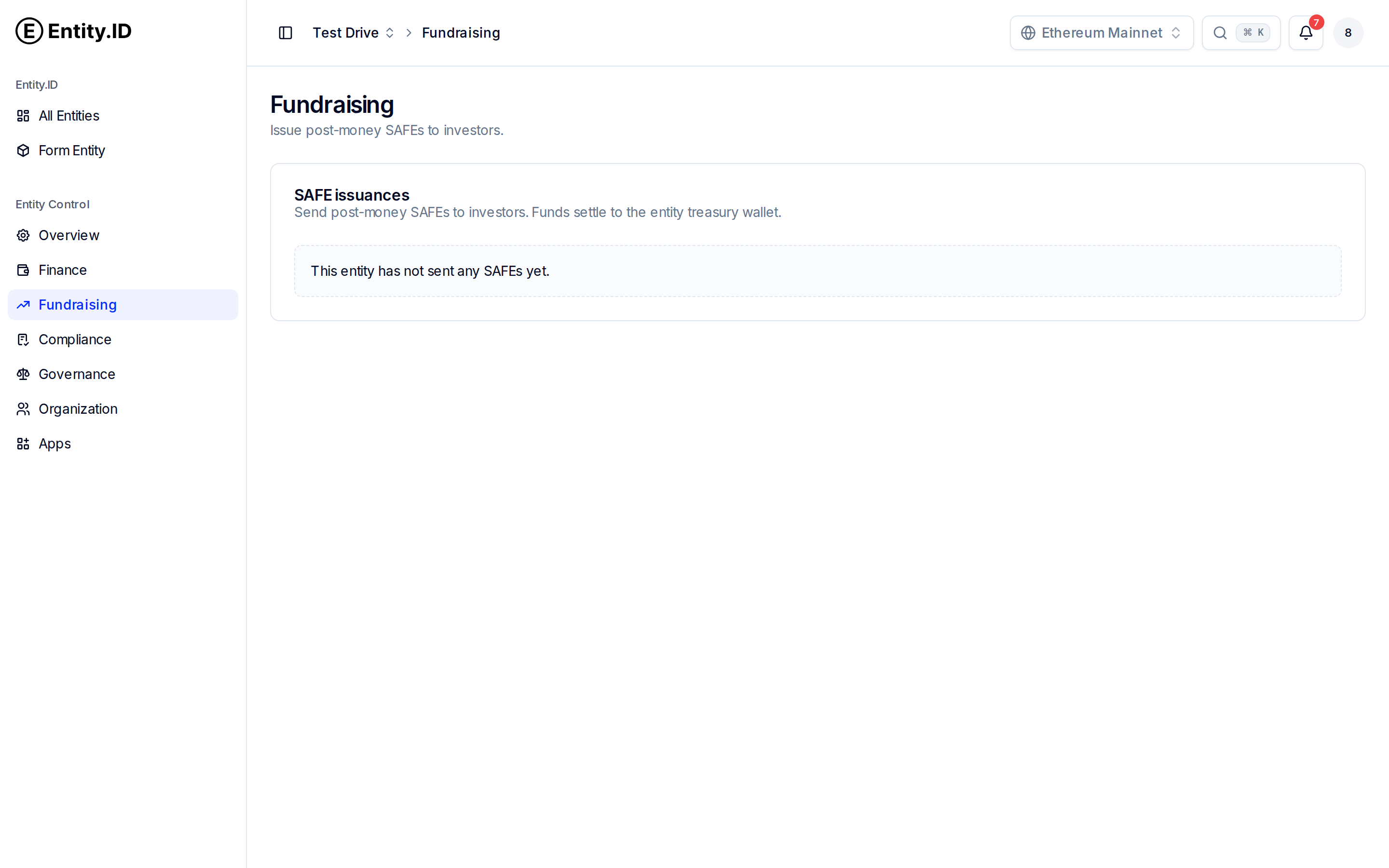
Fundraising module
Fundraising
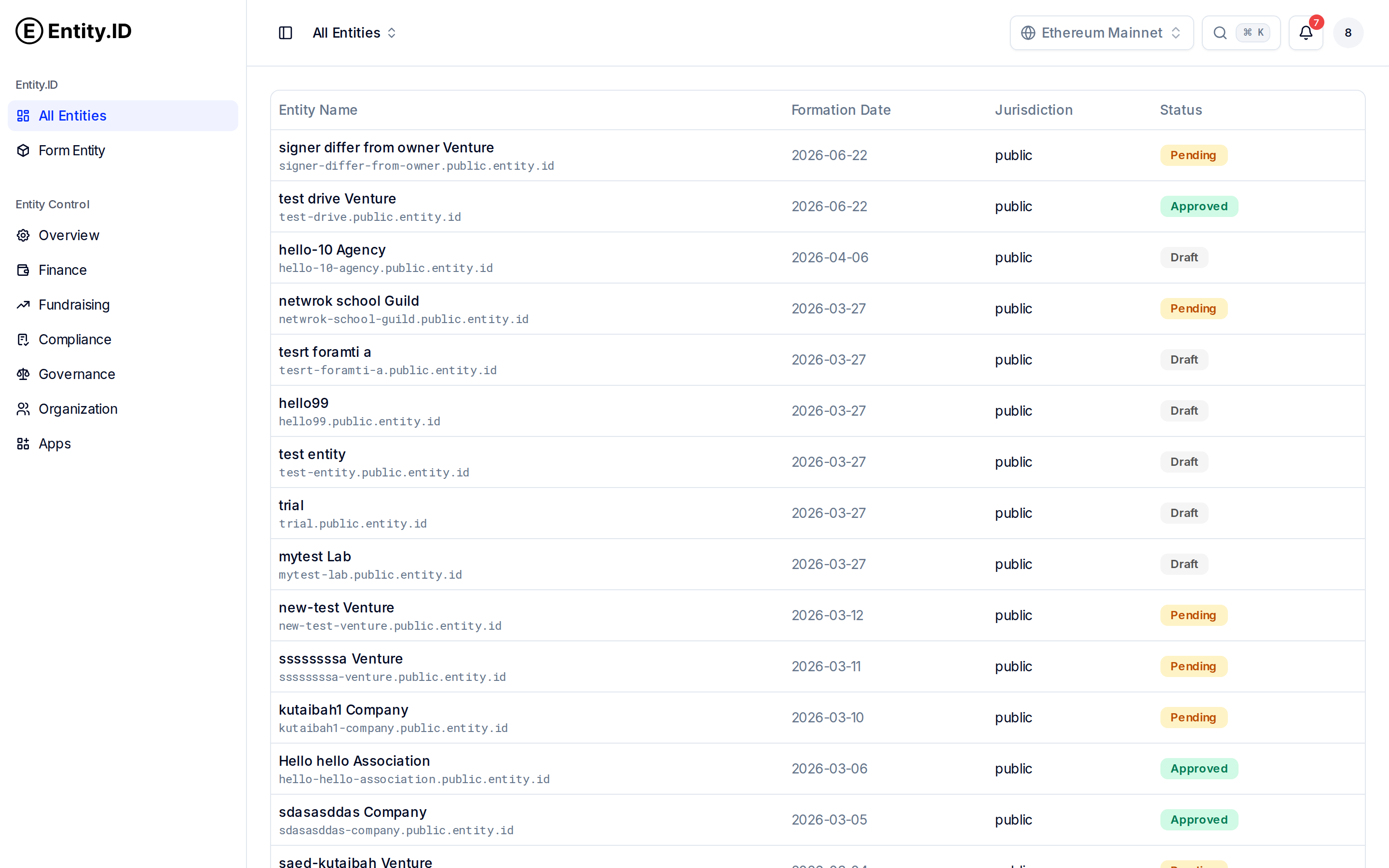
Registry entities list
The Registry
Who it's for

Three doors into the same registry.

Agent developers

Your agent is brilliant — and unbankable.

Register it within a venture and it gains a name counterparties can check, a treasury it can execute against, and a record that turns "unaccountable bot" into "party to the contract." Standing is the feature your agent is missing.

→ seat your first agent
Enterprises deploying agents

"The AI did it autonomously" is not a defense.

That's California statute since January 2026 — and the EU's disclosure clock runs out in August. Entity.ID structures, scopes, and discloses what your agents may do, so procurement, legal, and regulators get an answer instead of a shrug.

→ put your agents on the record
Founders of human + agent ventures

One founder. Five agents. A real company.

The hybrid venture is now a normal thing to want. Form it in minutes, seat the agents alongside the humans, split the ownership, set the rules — operate today, incorporate when you need to.

→ form a venture
Know your agent

The disclosure mandate has a date. The infrastructure didn't exist. We built it.

From August 2, 2026, EU law requires AI systems — explicitly including agents, per the Commission's draft guidance — to disclose that they're artificial. Banks are being told to move "beyond KYC, to know your agent." The FSB wants agents governed like synthetic employees, with clear accountability chains.

Entity.ID emits the artifact all of them are asking for — a machine-readable "I am an agent, registered as X, operated by Y, governed by Z" — as a by-product of registration. Compliance ships as a property of where the agent is registered, not as code every developer rewrites.

Aug 2, 2026
EU AI Act Article 50 disclosure duties become enforceable — explicitly reaching agents.
EU AI ACT · COMMISSION DRAFT GUIDANCE
$15T
of B2B spend forecast to run through agent exchanges by 2028 — 90% of B2B buying, agent-mediated.
GARTNER, NOV 2025
~69,000
agents already transacting ~$600M/yr over a single machine-payment protocol — none with a legal identity.
ECOSYSTEM-REPORTED, 2026
1999
the year machine-formed contracts became binding in the US (UETA §14 / E-SIGN). Capacity was never the gap. Standing is.
UETA · E-SIGN ACT
Precedent

Registries compound. They always have.

1819 → TODAY

Delaware

One state's registry hosts 2.28M entities and funds roughly a quarter of its General Fund. Registration is a product; jurisdictions monetize being good registries.

POST-2008

The LEI

Regulators created the Legal Entity Identifier because they couldn't identify counterparties in a crisis. 3M+ entities now carry one — compulsory across derivatives reporting. The first systemic agent incident produces the same demand.

2015 → 2025

HTTPS

Encryption went from 39% of the web to effectively all of it in a decade — the moment verification became free, automatic, and the unverified got branded "Not secure."

Agent verification is at its 2015. The registry that exists when the mandate lands, wins it.

The protocol

An open standard, not a walled garden.

Platform attestations stop at the platform's edge — an agent's identity inside one vendor's directory means nothing to an outside counterparty. Payment networks won't trust each other's attestations. The standing layer structurally wants a neutral, public standard.

The Entity.ID protocol is that standard: public, tamper-proof records; verifiable identity; standing checks any system can run — a payment rail, a marketplace, an insurer, another agent. Neutrality is the product.

standing check — the Entity.ID protocolPUBLIC · VERIFIABLE
$ GET /standing/atlas-1.atlas-research.public.entity.id

{
  "agent":        "ATLAS-1",
  "venture":      "atlas-research.public.entity.id",
  "role":         "treasurer",
  "owner_chain":  ["2 members", "2 verified humans"],
  "compliance":   { "model": "eu-ai-act.art50",
                    "arbitration": "kleros-v2" },
  "treasury":     { "mandate": "≤ $25,000/mo",
                    "scope": "governance-set" },
  "status":       "GOOD_STANDING",
  "record":       "tamper-proof · public"
}
The arc

Every economy gets the actors its law can see.

In 1819 the law learned to see companies — and capital organized. In 1999 it learned to accept a machine's signature. In 2026, agents move real money through rails that can't see them at all.

Entity.ID teaches the economy to see its newest actors — not by pretending they're human, but by registering them the way we registered everything else that mattered: with names, owners, rules, and someone who answers.

1819
Dartmouth College — the corporate charter becomes a protected legal fiction.
1886
Santa Clara — corporate personhood scales; capital gets standing.
1963
D-U-N-S — every business gets an identity strangers can trust.
1999
UETA — machine-formed contracts become binding law.
2012
The LEI — regulators mandate counterparty identity after the crisis.
2026
The company layer — agents register, gain standing, stay accountable.
Entity.ID

Give your agents standing.

Register a venture in minutes. Seat your agents. Let anyone check.

recognized ↔ recognized · the Entity.ID protocol · an open registry standard